
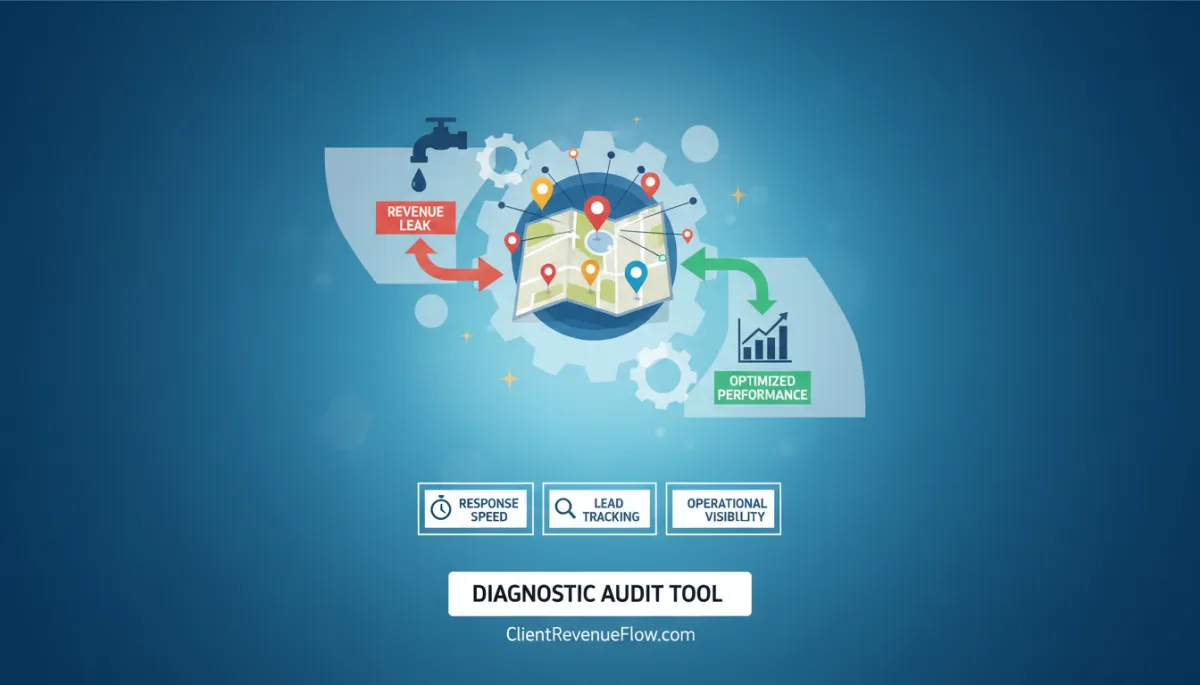
Per Location Revenue Leak Tracking for Trade Businesses
Home Services, Trade Businesses, Revenue Management
Home Services Blog 3: Per Location Revenue Leak Tracking for Trade Businesses
Discover how per location revenue leak tracking helps multi-location trade businesses close gaps in their sales process, respond faster to leads, and maximize revenue in every service area they operate.
Why Per Location Revenue Leak Tracking Matters for Trade Businesses
For trade businesses in home services—plumbing, HVAC, electrical, roofing, pest control, and beyond—growth rarely comes from a single territory. Most successful operators expand into multiple service areas, add satellite branches, or run several locations under one brand. While this growth is positive, it also introduces a critical challenge: uneven performance and hidden revenue leaks at the location level that are almost impossible to spot with only high-level reports.
Traditional reporting often aggregates results across the entire company—total calls, total jobs, total revenue. This masks the fact that one location may be converting leads at 70%, while another is stuck at 30%. Without per location revenue leak tracking, owners and agencies supporting these businesses are effectively managing blind spots. They see the overall numbers but cannot pinpoint where leads are slipping, where follow-up is failing, or where operational issues are silently eroding profit.
Implementing a structured system for per location revenue leak tracking changes that dynamic. It breaks performance down by branch, territory, or service area, making it possible to see exactly where revenue is being lost—whether in missed calls, slow responses, untracked leads, or poor booking rates. For trade businesses and the agencies that support them, this is the foundation for scalable, predictable revenue growth.
Turning Locations into Measurable Revenue Units
A multi-location trade business is not just one operation replicated; it is a collection of independent revenue units, each with its own demand patterns, staffing levels, and operational discipline. One location may be in a high-income suburb with strong inbound demand, while another covers a more price-sensitive market. Without per location tracking, you cannot accurately assess which differences are market-driven and which are operational or process-related leaks that can be fixed.
By treating each location as a measurable unit, you can monitor core metrics such as leads received, leads responded to, booked jobs, average ticket, and close rates separately. This allows you to see, for example, that Location A is losing revenue primarily due to slow response speed, while Location B is losing revenue because of weak lead tracking and follow-up. The same marketing campaign can perform very differently across locations; per location revenue leak tracking reveals why and where to intervene.
Agencies managing marketing for trade businesses also gain a more credible story. Instead of simply reporting on leads generated, they can tie performance to location-level outcomes—demonstrating where operational gaps are limiting ROI and where tightening processes could unlock significant hidden revenue. This elevates the agency from “lead provider” to “revenue partner,” backed by clear, location-based data.
How Per Location Tracking Identifies Revenue Leaks
Revenue leaks are not always dramatic events; they are often a series of small, repeated failures that accumulate into substantial losses. A call not answered here, a form submission missed there, a quote never followed up—multiplied across days, weeks, and locations. Per location revenue leak tracking isolates these leaks by following the journey of each lead within a specific location, from first contact to closed job or lost opportunity.
When your system logs leads by source and by location, you can see where they drop off. Are a high percentage of calls going to voicemail in one branch? Are web leads from a particular city rarely getting a response within an acceptable time frame? Is there a significant gap between quotes issued and jobs booked in a specific territory? Each of these patterns is a revenue leak, and they only become visible when viewed at the location level, rather than in aggregate.
Importantly, leak identification must go beyond simple volume metrics. A location might show strong call volume but weak booked revenue. Without granular tracking, the assumption might be “we need more leads.” With per location revenue leak tracking, you can instead determine whether the real issue is poor response speed, limited availability, or inconsistent follow-up. This allows owners and agencies to invest in the right fix—training, staffing, process, or technology—instead of simply buying more traffic.
Lead Tracking: The Backbone of Revenue Protection
At the core of any effective revenue leak strategy is robust lead tracking. Without accurate, per location tracking of every inquiry—phone call, web form, chat, referral—you cannot calculate conversion rates, response times, or follow-up performance. For multi-location trade businesses, this means assigning leads correctly to the right branch or service area, then monitoring how each location handles them over time.
Proper lead tracking ensures that no inquiry disappears into a black box. Each lead is timestamped, tagged with its source and location, and associated with key milestones: first response, booking attempt, quote issued, job completed, or marked as lost. When this data is aggregated at the location level, you gain a clear picture of how effectively each branch converts demand into revenue. This is essential for both internal accountability and for agencies seeking to prove the value of their marketing efforts beyond raw lead counts.
Without this discipline, businesses frequently underestimate how many leads slip through the cracks. A location may believe it has “called everyone back,” but the data may show dozens of leads with no documented response or follow-up. Per location revenue leak tracking, built on precise lead tracking, replaces assumptions with evidence and gives leadership the insight needed to allocate training, adjust staffing, or refine scripts where they will have the greatest impact.
Response Speed: The Hidden Multiplier of Revenue
In home services, response speed is often the deciding factor between winning and losing a job. Homeowners with a burst pipe, a failed AC unit, or an electrical issue rarely wait days for a reply; they call the next provider on the list. Per location revenue leak tracking highlights how quickly each branch responds to new inquiries, and how that speed correlates with booking rates and revenue performance in that specific area.
When response times are measured from the moment a lead arrives—whether via phone, web form, or other channel—you can compare locations side by side. One branch may consistently respond within minutes, while another averages hours. The latter may not perceive a problem internally, but per location data will show a clear pattern: slower responses, lower booking rates, and higher revenue leakage. This insight enables leadership to adjust staffing, implement call routing, or introduce standardized response protocols where they are needed most.
Agencies also benefit from this visibility. When they can show that leads generated from campaigns are not being responded to quickly in a particular location, they can credibly explain why results lag and recommend operational improvements. Instead of being blamed for “low quality leads,” the data demonstrates that revenue is being lost due to response speed issues at specific locations, not a failure of marketing. This shifts the conversation from blame to collaboration and process optimization.
Improving Lead Follow-Up at the Location Level
Initial response is only the first step. Many trade jobs, especially higher-ticket projects, require multiple follow-ups before a homeowner commits. Quotes may need clarification, timing may shift, or decision-makers may need reminders. Per location revenue leak tracking allows you to see how consistently each branch follows up on open quotes, unbooked estimates, and pending proposals, and how that discipline affects revenue outcomes in that specific market.
When follow-up actions are recorded and tied to each lead, you can analyze patterns such as: How many follow-up attempts are made per location? Over what time frame? What percentage of quotes receive no follow-up at all? Which location closes the highest percentage of jobs after two or more follow-ups? This level of detail reveals where revenue is leaking due to inconsistent or insufficient follow-up, and where best practices from high-performing locations can be replicated across the organization.
With clear tracking in place, leadership can set minimum follow-up standards per location—such as a required number of touchpoints over a set period—and then monitor compliance. Locations that adhere to these standards typically see a measurable increase in booked revenue without any increase in marketing spend. In other words, better follow-up turns existing demand into additional revenue, and per location tracking shows exactly where that potential is being realized or wasted.

Centralized visibility into per-location metrics exposes patterns of missed follow-up and slow responses.
Operational Visibility: Seeing What Happens After the Phone Rings
Lead generation is only one part of the revenue equation. What truly determines profitability is what happens after the phone rings or the form is submitted. Operational visibility—knowing how each location handles leads, schedules jobs, allocates technicians, and manages capacity—is essential for understanding why some locations outperform others and where revenue is leaking. Per location revenue leak tracking gives owners and agencies a window into these operational realities, rather than relying on anecdotal reports or assumptions.
With proper tracking, you can see whether a location is frequently turning away jobs due to lack of capacity, double-booking technicians, or failing to prioritize high-value leads. You can identify patterns such as high cancellation rates in a particular branch or consistently low average ticket size in another. Each of these patterns indicates a different type of operational issue, and each is a potential revenue leak. Without per location visibility, these issues remain hidden behind overall company averages.
For agencies, operational visibility is equally important. It clarifies whether underperformance in a specific location is due to marketing, operations, or both. This allows agencies to make informed recommendations—such as adjusting campaign budgets by location, refining targeting, or collaborating with the client on staffing and scheduling strategies—based on concrete data rather than guesswork. In short, operational visibility transforms per location tracking into actionable revenue strategy.
Optimizing Each Location’s Performance with Data-Driven Insights
Once per location revenue leak tracking is in place, the real value comes from using those insights to optimize each location’s performance. Rather than applying generic improvements across the entire business, leadership can tailor strategies to the specific needs of each branch. One location may need better scripting and training for CSRs, another may require improved scheduling processes, while a third may need additional marketing support to reach its full capacity.
High-performing locations can serve as internal benchmarks. By comparing key metrics—lead-to-booking conversion, average response time, follow-up completion, and revenue per lead—across locations, you can identify what the top branches are doing differently. These best practices can then be standardized and rolled out across the network, creating a consistent customer experience and lifting overall performance. This is only possible when you have clear, comparable, per location data rather than blended company-wide averages.
For agencies, this optimization process presents an opportunity to deepen client relationships. By helping clients interpret location-level data and prioritize improvements, agencies move beyond campaign management into strategic revenue consulting. They can recommend where to shift budget, which locations are ready for growth, and where operational improvements must precede additional lead volume. This alignment of marketing strategy with per location performance makes every dollar of ad spend more effective and more defensible.
Bringing It All Together with a Diagnostic Approach
Per location revenue leak tracking is not just about collecting data; it is about using that data to conduct a structured diagnostic audit of each location. By reviewing lead tracking accuracy, response speed, follow-up consistency, and operational visibility for every branch, you can quickly identify where revenue is being left on the table and what changes will produce the highest return. This diagnostic approach is particularly powerful for trade businesses with multiple service areas, where even small improvements per location can add up to significant company-wide gains.
A well-designed diagnostic tool guides owners and agencies through this process, highlighting gaps, quantifying potential revenue recovery, and prioritizing actions. Instead of guessing which location needs attention, you can see it clearly in the numbers. Instead of debating whether the issue is leads or operations, you can point to specific metrics that show where the leaks occur. This clarity accelerates decision-making and ensures that time and resources are invested where they will have the greatest impact on revenue.
If you are a trade business owner or an agency partner working with multi-location home service brands, now is the time to move beyond surface-level reporting. Implement per location revenue leak tracking, deepen your lead tracking discipline, and shine a light on response speed and operational visibility across every branch. The revenue you gain will not come from more ads alone, but from capturing the full value of the leads you already have.
