AI Call Capture for Physical Therapy & Chiropractic
AI Call Capture, Physical Therapy, Chiropractic Practices, Revenue Recovery, Patient Inquiries, Missed Calls
CRF Chiropractor Blog 9: AI Call Capture for Physical Therapy Practices
In a world where patients expect instant access and seamless communication, every missed call is more than an inconvenience—it is a potential lost patient, a delayed treatment plan, and a hit to your bottom line. AI Call Capture for Physical Therapy Practices and Chiropractic Practices is no longer a nice-to-have; it is a strategic necessity for revenue recovery, patient satisfaction, and sustainable growth. This is where Client Revenue Flow (CRF) steps in, turning missed calls into organized, trackable, and recoverable opportunities.
Why AI Call Capture Matters for Physical Therapy and Chiropractic Practices
For most Physical Therapy and Chiropractic Practices, the phone is still the primary “front door.” New patients call to schedule evaluations, existing patients call to reschedule, and referring physicians’ offices call to coordinate care. Yet front desk teams are constantly juggling in-clinic patients, insurance questions, documentation, and administrative tasks. The result: missed calls that quietly erode patient trust and revenue potential.
Industry research shows that missed appointments and poor communication cost the U.S. healthcare system billions of dollars each year in lost productivity and unrealized revenue. Healthcare Finance News notes that missed appointments alone are a major contributor to revenue leakage, and ineffective communication is a root cause of many of those no-shows and cancellations. When a patient cannot get through on the phone, they often do not reschedule—they simply disappear, or worse, they call a competitor who picks up on the first ring.
At the same time, patient behavior is shifting. By 2026, an increasing share of patients are using AI tools, chatbots, and online search as their first step in seeking care. Studies cited by HLTH and MedSoftwares show that tens of millions of people ask AI health questions every day, often outside business hours. This means your practice has to be responsive, organized, and always-on—not just during the 9–5 window when your front desk is staffed. AI Call Capture bridges this gap, ensuring that every call, every voicemail, and every inquiry is captured, analyzed, and actioned.
📌 Key Takeaway: If your practice is not using AI Call Capture, you are likely leaving patient relationships and revenue on the table every single day.
The Hidden Cost of Missed Calls in Rehabilitation Practices
In rehabilitation-focused environments like physical therapy and chiropractic clinics, each new patient call represents a multi-visit care plan, not just a single appointment. A missed call for an initial evaluation could represent 6, 12, or even 20+ future visits depending on the treatment plan. When that call is not answered or not returned promptly, your practice loses not only the first visit but the entire lifetime value of that patient episode of care.
Beyond new patients, missed calls also undermine revenue recovery from existing patients. Patients call to clarify benefits, ask about balances, or reschedule after a cancellation. If those calls are not captured and organized, they can lead to delayed billing, write-offs, or no-shows that never get rebooked. Healthcare IT and revenue cycle studies show that better call management and automated reminders significantly reduce missed appointments and improve cash flow, yet many outpatient rehab practices still rely on manual phone logs or sticky notes at the front desk.
The impact is cumulative. A few missed calls per day can turn into dozens of lost evaluations per month and hundreds of lost visits per quarter. For multi-location practices and agencies managing multiple clinics, the financial exposure is even greater. Without a systematized way to track missed calls and patient inquiries, leadership cannot see where the leaks are, which locations are underperforming, or how many opportunities could be recovered with better processes.
💡 Pro Tip: Start treating every missed call as a measurable revenue event, not just a minor inconvenience. AI Call Capture makes that possible.
What Is AI Call Capture and How Does It Work?
AI Call Capture is a technology layer that sits on top of your existing phone system and digital communication channels. Instead of relying on staff to manually write down voicemails or remember to return calls, an AI-driven system automatically records, transcribes, and classifies each incoming call—answered or missed. Using advanced natural language processing (NLP), the AI can understand the intent of the caller, identify whether they are a new or existing patient, and categorize the reason for contact (e.g., new evaluation, reschedule, billing question, referral inquiry).
By 2026, AI tools in healthcare are expected to integrate seamlessly with scheduling systems and electronic health records (EHRs). This means that when a patient calls about an appointment, the AI can not only capture the message but also surface relevant patient information and possible appointment slots to your staff. According to Healthcare IT News and TechTarget, AI-powered contact center solutions are already enabling patients to complete tasks like scheduling and basic triage without staff intervention, freeing your team to focus on high-value interactions and in-person care.
For physical therapy and chiropractic environments, this level of automation is particularly valuable. Many calls are routine—questions about directions, insurance coverage, or appointment times. AI can capture and structure these patient inquiries, while flagging high-priority opportunities such as new referrals or post-surgical rehab requests. Rather than combing through voicemail boxes or handwritten notes, your team works from a single, organized queue of tasks that are prioritized based on revenue impact and patient urgency.
📌 Key Takeaway: AI Call Capture turns unstructured phone chaos into structured, actionable data your team can execute on immediately.
From Missed Calls to Revenue Recovery: The CRF Advantage
Client Revenue Flow (CRF) is designed specifically to help Physical Therapy and Chiropractic Practices transform their communication gaps into measurable revenue gains. Rather than offering generic call tracking, CRF focuses on the full lifecycle of a missed call—from the moment the patient reaches out to the point when the appointment is scheduled, completed, and billed. This closed-loop approach is what drives true revenue recovery, not just better reporting.
When a call is missed, CRF’s AI Call Capture automatically records the voicemail, transcribes the content, and tags it based on intent and value. For example, a voicemail that says, “My doctor just referred me for post-op knee rehab and I need to schedule,” is flagged as a high-value new evaluation. The system can then assign that lead to the appropriate location or staff member, track when the follow-up occurs, and record whether the patient ultimately books and completes their plan of care. Every step is logged, giving you a clear view of how well your team converts missed calls into visits.
This level of tracking is crucial for multi-site operators and agencies. Without it, there is no way to know if your marketing dollars and referral relationships are truly paying off. CRF’s focus on revenue recovery means you can quantify exactly how much potential revenue was at risk due to missed calls and how much you were able to save by implementing an organized, AI-driven follow-up process. Over time, these insights inform staffing decisions, marketing strategies, and operational improvements that compound your return on investment.
💡 Pro Tip: Do not just measure call volume—measure how many missed calls turn into completed plans of care. That is true revenue recovery.
Organizing and Tracking Patient Inquiries with CRF
One of the most powerful aspects of CRF is how it helps organize and track patient inquiries across all your communication channels. Instead of scattered voicemails, emails, and sticky notes, CRF consolidates every inquiry into a centralized, structured dashboard. Each item is associated with key metadata: location, source (phone, web form, referral), caller type, reason for contact, and estimated revenue value. This allows your team to work from a prioritized, transparent queue rather than a chaotic inbox.
For example, a typical day might include new patient calls, physician referrals, reschedule requests, and billing questions. CRF’s AI Call Capture automatically classifies these inquiries so your staff can quickly see what needs attention first. New evaluations and physician referrals can be escalated, while lower-value questions can be addressed in batch or via automated messaging where appropriate. Over time, your team becomes more efficient, and your patients experience faster, more consistent responses.
For business owners and agency partners, this level of organization unlocks critical analytics. You can see trends in call volume by time of day, location, and campaign. You can measure how long it takes your team to respond to missed calls and how that response time correlates with conversion rates. You can even identify training opportunities—such as staff who struggle to convert inquiries into scheduled evaluations—because every interaction is documented and measurable.
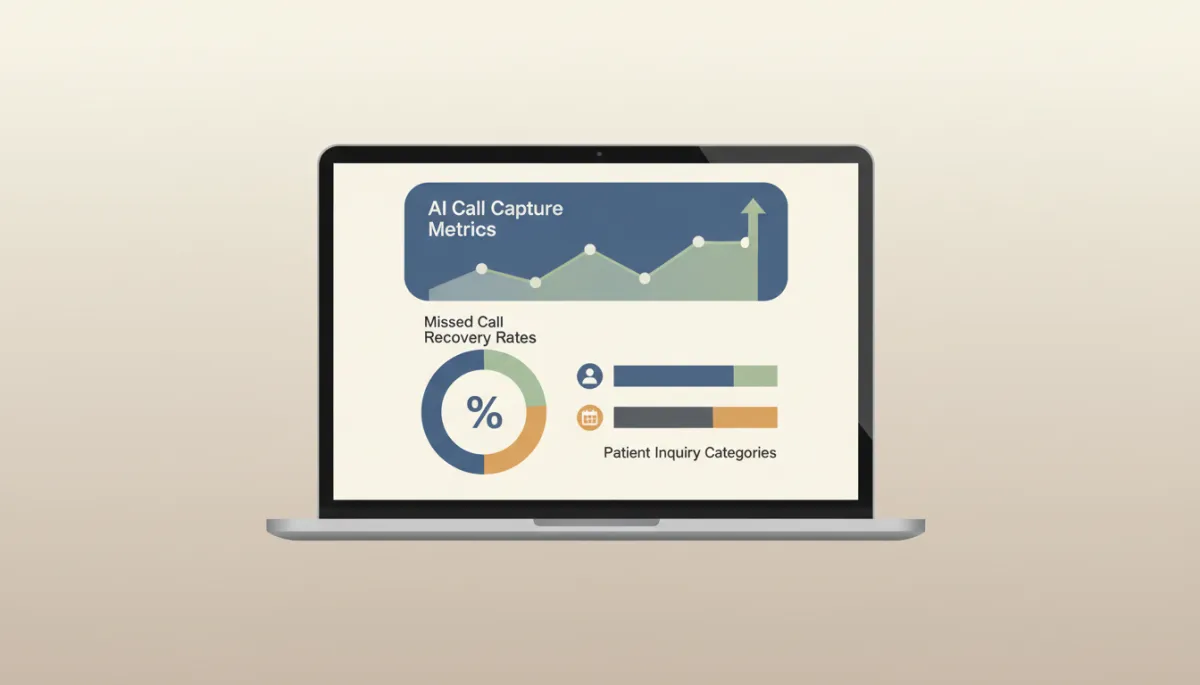
Visibility into missed calls and conversions reveals hidden revenue and operational gaps.
📌 Key Takeaway: When every patient inquiry is captured, categorized, and tracked, you can finally manage your communication process with the same rigor as your finances.
Enhancing Patient Experience While Protecting Privacy
Modern patients expect quick answers, clear communication, and flexibility. AI Call Capture supports this by ensuring that no inquiry falls through the cracks and that follow-up is timely and relevant. At the same time, healthcare organizations must protect patient privacy and comply with regulations such as HIPAA. Emerging trends in AI for healthcare emphasize strong data encryption, secure storage, and access controls to keep sensitive information safe while still enabling efficient workflows.
CRF’s approach aligns with these trends by focusing on secure handling of call recordings and transcripts, role-based access, and audit trails. As AI adoption grows across the healthcare sector, trust and governance have become central themes. Surveys like Wolters Kluwer’s Future Ready Healthcare report show that both clinicians and patients are increasingly comfortable using AI—provided it is implemented transparently and responsibly. For physical therapy and chiropractic settings, this means using AI as a support tool that augments, rather than replaces, human judgment and patient relationships.
When implemented correctly, AI Call Capture becomes an invisible backbone of your communication strategy. Patients experience faster callbacks, fewer dropped interactions, and more consistent service. Your staff experiences less stress, fewer manual tasks, and clearer priorities. And your leadership team gains the confidence that your communication infrastructure is both patient-centric and compliant with evolving regulatory expectations.
💡 Pro Tip: Communicate to patients that AI supports your responsiveness and privacy, but that real people still make the care decisions.
Strategic Benefits for Business Owners and Agencies
For owners of physical therapy and chiropractic clinics—and for agencies that support them—AI Call Capture is more than an operational tool. It is a strategic lever for growth. By providing granular visibility into missed calls, response times, and conversion rates, CRF gives you the data you need to make informed decisions about staffing, marketing, and expansion. You can answer questions like: Which clinics are losing the most opportunities? Which campaigns are generating high-intent calls that are not being converted? How does after-hours call volume compare to daytime traffic, and what is that worth in potential revenue?
Agencies, in particular, benefit from being able to prove the ROI of their marketing efforts. Instead of vague attribution, you can show clients exactly how many calls your campaigns drove, how many of those calls were missed, and how many were ultimately recovered and turned into completed plans of care. This level of transparency strengthens client relationships and justifies increased investment in growth initiatives. It also differentiates your agency in a crowded marketplace, positioning you as a partner focused on real business outcomes, not just clicks and impressions.
As AI continues to reshape patient behavior and expectations, organizations that proactively adopt tools like CRF’s AI Call Capture will be better positioned to compete. They will respond faster, convert more inquiries, and retain more patients over the full course of care. Those who cling to manual processes and fragmented communication systems will find it increasingly difficult to keep up with both patient expectations and financial pressures.
📌 Key Takeaway: AI Call Capture is not just an IT decision—it is a strategic growth decision that directly impacts valuation, scalability, and competitive positioning.
Next Steps: Diagnose Your Missed Call and Revenue Recovery Gaps
If you are like most physical therapy and chiropractic leaders, you probably have a sense that missed calls are costing you money—but you may not know how much, where, or why. The first step is to move from guesswork to data. That is exactly what CRF’s diagnostic approach is designed to do: quantify your current performance, uncover the gaps, and map out a plan to capture more of the revenue you are already generating demand for.
By leveraging AI Call Capture, structured patient inquiry tracking, and a focus on revenue recovery, CRF helps you build a communication engine that supports both clinical excellence and financial health. In an environment where margins are tightening, staffing is challenging, and patient expectations are rising, this kind of operational intelligence is no longer optional. It is the foundation for sustainable growth and resilient practices.
Whether you operate a single clinic, manage multiple locations, or run an agency that serves rehab practices, now is the time to evaluate how well your organization captures, organizes, and acts on every patient call. The technology is ready. The patient behavior shift is already here. The only question is whether your practice will treat AI Call Capture as a competitive advantage—or continue to let missed calls silently drain your revenue potential.
💡 Pro Tip: A focused diagnostic audit often reveals that the fastest path to growth is not more marketing—it is better capture and conversion of the demand you already have.
